Restaurant Kiosk Cost: What You Need to Know
You don’t need a tech background or a massive budget to get kiosks for your restaurant. But you do need a clear understanding of what they actually cost, and more importantly, what you’re paying for.
Over the past few years, restaurant kiosks have gone from a cool upgrade to a strategic investment. They improve several elements for businesses, going from order accuracy to speeding up the service.
Still, one of the biggest questions that operators have is quite simple: how much is this really going to cost me? And the answer isn’t a single price tag. Every restaurant owner wants a kiosk that perfectly represents their design and simplifies things for them exactly the way they want. But on an affordable budget.
The costs for restaurant kiosks can vary widely depending on your setup and goals. If you’re considering adding a kiosk to your restaurant, KioskSys’ blog will walk you through everything you need to know to make the final decision.
What is a Restaurant Kiosk?
A restaurant kiosk is basically a self-service digital ordering system. It allows customers to perform certain tasks without needing to interact directly with the staff (introvert blessing). This includes actions like:
- Browsing the menu
- Customizing their meals
- Placing orders
- Generate order no. slips
- Make payments
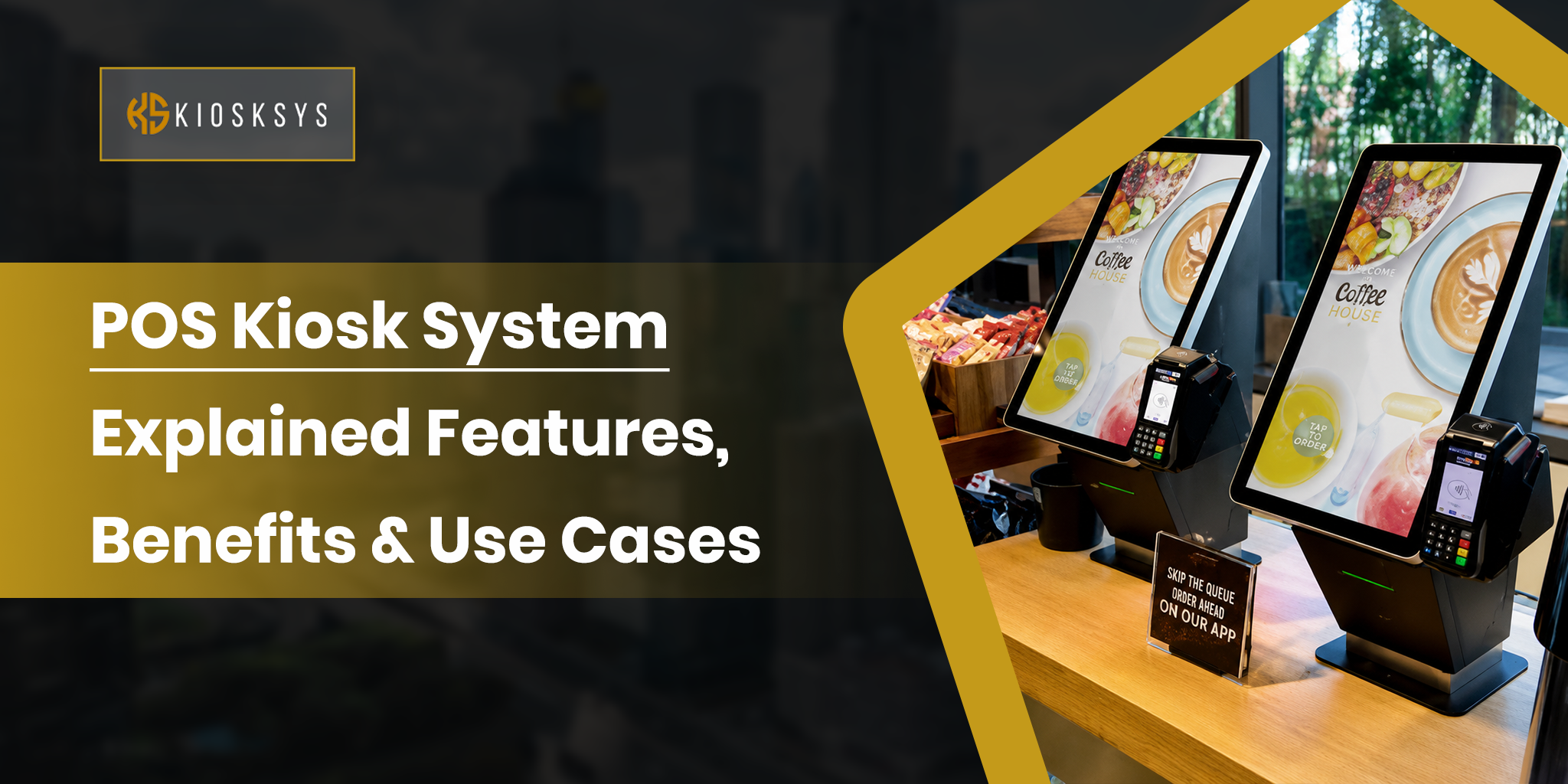
These kiosks are designed to make things easier for both the staff and the customers. Customers can easily take their time and explore whatever they want to have, and they can even pay directly through the system.
You’ve probably seen them in some restaurants (e.g., KFC, McDonald’s), usually as huge touchscreens that look like tablets placed near the entrance or counter.
These kiosks often integrate with POS and inventory management systems. This is one of the reasons why more businesses are evaluating the fast food kiosk system cost. Because this is an investment that comes with great ROI.
What types of restaurants use kiosks?
Restaurant kiosks aren’t limited to one specific type of business. You can get a restaurant kiosk if you’re running a global food chain, or you can still get one if you have a small cafe. They’re flexible enough to fit different service models. Here’s how they’re commonly used across different restaurant categories:
Quick-Service Restaurants
Quick-service restaurants (QSRs) are the biggest adopters of kiosks. In this segment, everyone who comes by is expecting quick service. Here, restaurant kiosks help in:
- Reducing long lines
- Minimizing order errors
- Customizing customer meals without feeling rushed
They also tend to increase the average order value through smart upselling prompts.
Casual Dining Restaurants
While casual dining is traditionally more focused on the human touch in its services, many restaurants are starting to adopt kiosks in creative ways. Kiosks here often complement the dining experience via:
- Handling waitlists
- Enabling quick reorders
- Allowing customers to pay at the table
This hybrid approach keeps the human touch intact.
High-Volume & Specialized Locations
Places like food courts, airports, and campus dining halls benefit massively from getting restaurant kiosks. These places get constant high traffic, so it is expected. Kiosks help manage large crowds efficiently while keeping lines moving.
How Much Does a Restaurant Kiosk Cost? Full Breakdown
If you find yourself asking, “Is a restaurant kiosk worth it?” you’re already thinking in the right direction. Because the real answer involves understanding each aspect, even the technical ones.
Basic Kiosk (Entry-Level Setup)
Best for: small cafés, startups
A basic kiosk setup usually costs between $500 to $2,500.
At this level, you’re getting a simple ordering system—customers can browse the menu to place orders and pay. The software is simple, handling basic POS integration and order processing, but it won’t offer much in terms of customization or advanced upselling.
Mid-Level Kiosk (Most Popular Choice)
Best for: growing QSRs and fast-casual restaurants
This is where most restaurants invest in good, and most get custom kiosk software for restaurants built. It typically ranges from $2,500 to $5,000.
Here, it’s smarter software working in the background. Your kiosk can suggest add-ons, connect with loyalty programs, and do a lot more.
Enterprise Kiosk (Advanced & Scalable)
Best for: high-volume restaurants and fast food chains
Enterprise-level kiosks can cost anywhere from $5,500 to $10,000+ per unit.
At this level, everything is more advanced. You’re managing multiple locations that are syncing data across the systems to make sure it matches, alongside other things. They use these detailed analytics to make decisions.
Here’s a table to provide an overview:
Restaurant Kiosk Cost Breakdown
Kiosk Type | Estimated Total Cost | What’s Included |
Basic Kiosk | $1,000 – $3,000 | Complete kiosk with ordering and payment system, with basic software customization and POS integration |
Mid-Level Kiosk | $3,000 – $9,000 | Commercial-grade kiosk with a smarter custom system with upselling and reporting |
Enterprise Kiosk | $8,000 – $25,000+ | Advanced, full-feature system with full software customization, analytics, and deep integrations |
What’s the total first-year cost if you’re buying 2–3 kiosks?
If you’re planning to install more than one custom restaurant kiosk (which most restaurants do), the cost naturally goes a bit higher. However, the restaurant kiosk ROI can also be higher, especially when companies build custom kiosk solutions. They just need to be implemented carefully and with a strategic mindset.
Typical First-Year Cost (2–3 Kiosks)
Number of Kiosks | Estimated First-Year Cost (All-In) |
2 Kiosks | $6,000 – $18,000 |
3 Kiosks | $9,000 – $27,000 |
What are the Factors That Affect Your Restaurant Kiosk Cost?
When you start looking into the prices of kiosks for restaurants, you’ll quickly realize that there are several parts that influence the final cost.
Beyond the base setup that you can see, these factors can significantly increase or optimize what you end up paying.
Let’s break down the key ones:
Installation and Onboarding
This is one of the most overlooked costs. Installation isn’t just about placing a kiosk in your restaurant… It includes physical technical stuff like:
- Wiring
- Mounting
- Payment terminal setup
- System configuration
On top of that, onboarding involves setting up your menu and making sure everything runs smoothly.
POS Customization
Your kiosk needs to directly communicate with your POS system, and that’s where customization comes in.
If your menu has:
- Modifiers
- Combos
- Dynamic pricing
- Location-specific variations
Then, customization takes more time and money. However, restaurants get several benefits out of this.
Kiosk Type (Countertop vs. Freestanding)
The physical type of kiosk also plays a big role in the pricing.
- Countertop kiosks are more compact and generally more affordable. They’re ideal for smaller spaces or businesses that are just starting out.
- Freestanding kiosks are larger and are designed for high-traffic locations that get lots of people regularly.
Whichever one you choose will affect the costs accordingly.
What are the Hidden Costs Restaurants Should Watch Out For?
Knowing the restaurant kiosk hidden fees is vital for companies that are planning to invest in them. This way, they’re able to stay prepared for what’s coming.
Maintenance and Support
In anything that has to do with technology, maintenance and support are incredibly vital. They are what make sure that any system, whether it’s a mobile app or a kiosk system, stays secure and user-friendly.
Order Volume/Processing Power
This is one that many restaurant owners don’t expect. As your order volume grows, your kiosk system needs to handle more transactions smoothly. So if your business grows (which is the goal), your costs may increase alongside it. The more powerful and responsive you want your system to be, the more you may end up paying.
Staff Training
Everyone can use a touchscreen solution these days; the reason you’ll need to afford staff training is that you can’t call for professional help every time the kiosk is in need of troubleshooting or a wiring-related problem.
Long-Term Budget
It’s easy to focus on the first-year costs, but restaurant kiosks are a long-term investment. Over time, you may need:
- Software upgrades
- Hardware replacements or repairs
- Feature add-ons as your business grows
Getting a Restaurant Kiosk vs. Hiring a Cashier: What is the Real Cost Comparison?
The ultimate question that companies ask: kiosk vs cashier cost, restaurant version. Of course, kiosks aren’t a light investment; you’re paying in hundreds and thousands of dollars, but you’re still doing the same if you keep a human cashier. For one, you’re paying all the costs initially, and for the other, you might be paying weekly/monthly. But the real question is: which is cheaper?
Ask yourself these questions:
What does it cost to employ a full-time cashier for one year?
A single cashier doesn’t just take a monthly salary. The real cost includes:
- Monthly wages
- Training and onboarding
- Payroll taxes and benefits (where applicable)
- rehiring costs
- Scheduling problems during peak/off-peak hours
At what order volume does a kiosk become cheaper than a cashier?
A kiosk has a fixed cost, but it doesn’t scale with hours worked or breaks taken. That means:
- During peak hours, one kiosk can process multiple orders continuously
- It doesn’t require overtime pay or shift coverage
- It can handle consistent throughput without fatigue
Does a kiosk actually replace a staff member, or just assist them?
Instead of having cashiers manually taking every order, the staff can shift toward:
- Order fulfillment
- Customer assistance
- Kitchen coordination
- Quality control
What do restaurants like McDonald’s and Shake Shack report about kiosk ROI?
Large QSR brands that have adopted kiosks at scale consistently report similar outcomes:
- Higher average order value due to automated upselling
- Faster service times during peak hours
- Reduced dependency on front-counter staffing
- Improved order accuracy
Conclusion
The real takeaway in getting restaurant kiosks for your business isn’t how much they cost, but how they reshape the way your restaurant handles ordering, flow, and customer behavior over time.
Instead of thinking in terms of expense versus savings, it’s more about whether your setup is ready for a system that actively influences how your service runs day to day.