What Is Generative AI?
Generative AI refers to systems that create new content based on patterns learned during training. That content might be text, images, code, video, audio, or design assets, depending on what the system was built for.
These tools don’t just retrieve existing information. They generate something new based on what they’ve learned from enormous amounts of data.
You write a prompt. The system analyses your request. It predicts the most useful response. Outcomes are a blog post, a marketing email, a function in Python, or an image of whatever you described.
That’s why content generation technology has become such a fixture in creative work, software development, and marketing.
How Does Gen AI Work?
For all the sophistication on display, the underlying process comes down to prediction and pattern recognition.
Large Language Models
Large language models, commonly called LLMs, are the backbone of most text generation systems. They learn language patterns, word relationships, grammar, and context from vast amounts of text during training.
When you ask a random question, the model predicts the most likely useful response based on everything it absorbed during that process.
Training on Vast Datasets
These models train on billions of words pulled from books, articles, websites, research papers, and other sources.
That training teaches the AI things like:
- Language patterns
- Context
- Writing styles
- Facts and concepts
- Relationships between ideas
Larger, better quality datasets generally produce more capable models.
Prompt Response Interactions
Generative systems depend heavily on how you prompt them. A vague instruction produces a vague result. A specific one tends to produce something much more useful.
“Write a product description” versus “Write a friendly product description for a fitness smartwatch aimed at complete beginners” will get you very different outputs. The second one gives the system enough to work with.
Common Generative AI Applications
Content creation tools have spread across practically every industry at this point. From Retail to Healthcare, to even niche industries that you didn’t know existed.. They all utilize this form of artificial intelligence.
Content Creation: ChatGPT
ChatGPT is the most recognisable example. Businesses use it for writing articles, drafting emails, brainstorming ideas, and handling all kinds of written communication.
Image Generation: Midjourney
Midjourney creates images from text descriptions, which has become genuinely useful for designers, marketers, and anyone who needs visuals quickly without a full production process behind them.
Code Generation: Cursor
Cursor helps developers write code, suggests fixes, and generally speeds up the development process considerably.
Marketing and Customer Support: Zendesk AI
Zendesk’s AI features help businesses automate responses, summarise conversations, and support customer service teams handling high volumes.
Product Descriptions and Documentation: ChatPRD
ChatPRD helps teams produce product documentation, requirements, and descriptions faster than doing it entirely manually.
What Is Agentic AI?
Agentic AI, sometimes called autonomous AI or goal-directed AI, refers to systems that can simply pursue objectives, make decisions along the way, use external tools, and complete tasks with limited human involvement throughout
Rather than generating content in response to a prompt, these systems can:
- Understand objectives
- Break work into smaller tasks
- Make decisions
- Access external tools
- Evaluate their own results
- Adjust their approach
A content generation system answers questions. An autonomous AI agent attempts to actually solve problems.
Instead of writing a report about inventory levels, an AI agent might monitor stock in real time, detect shortages, initiate purchase requests, and notify the right people, all without being prompted to do each step individually.
How Does Agentic AI Work?
Several things separate these goal-directed systems from standard content generation models.
Goal Setting
Rather than receiving a single question, the system receives an objective.
“Reduce inventory shortages by 20 percent” is the kind of instruction an autonomous agent works toward rather than simply describing.
Task Decomposition
Large goals get broken into smaller sequential tasks. The system figures out what needs to happen first and what follows from there.
Decision Making
Agent-based systems evaluate information continuously and choose actions based on what the data is telling them. That lets them adapt when conditions change rather than getting stuck when something doesn’t go exactly to plan.
Tool Usage
Most intelligent agent systems connect to external tools like:
- Databases
- APIs
- Business software
- Analytics platforms
- Scheduling systems
This is what allows them to take actual action rather than just producing text about what someone else might do.
Memory and Feedback Loops
More advanced autonomous systems remember previous interactions, learn from outcomes, and get better over time. The feedback loop is what makes them increasingly effective the more they’re used.
Common Agentic AI Applications
Several industries are already putting these intelligent automation systems to work.
Autonomous Business Workflows: CrewAI
CrewAI enables multiple AI agents to collaborate and complete business tasks together, dividing work between specialised agents.
IT Operations: Splunk AI Assistant
Splunk’s AI assistant helps identify issues, investigate incidents, and support IT teams managing complex infrastructure.
Supply Chain Optimization: Oracle Fusion Cloud SCM
Oracle Fusion Cloud SCM uses goal-directed AI capabilities to improve forecasting, planning, and supply chain operations.
Smart Vending Management: 365 Retail Markets
365 Retail Markets uses intelligent automation to improve unattended retail operations and inventory management across vending networks.
Research Assistants: Perplexity
Perplexity combines research and information retrieval capabilities to help users investigate complex topics more effectively than a standard search.
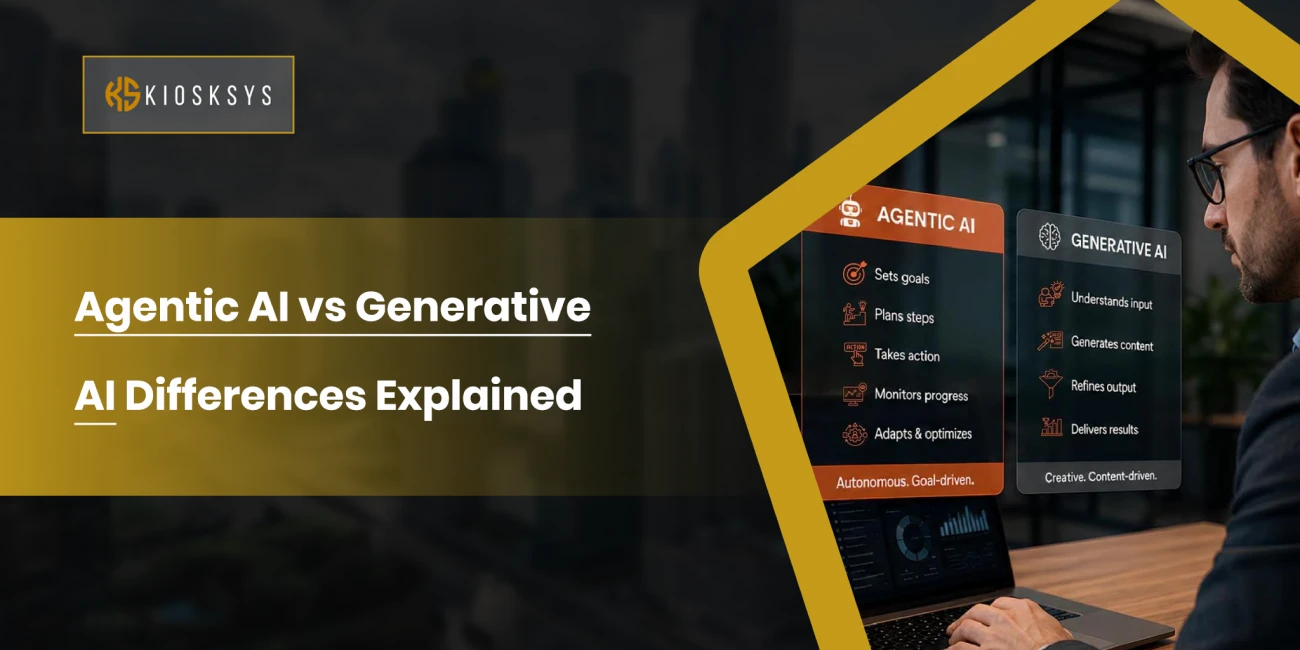
Agentic AI vs Generative AI: Key Differences
Even when both types of systems use large language models under the hood, their purposes diverge significantly.
1. Purpose
Content generation tools create outputs, now this could be anything from text to images and videos. Autonomous AI systems complete tasks that are often related to businesses.
2. Autonomy
Generative models wait to be told what to do. Goal-directed agents can act independently once they have an objective.
3. Decision Making
Creative AI tools don’t make operational decisions. Autonomous systems evaluate options and choose actions based on available information.
4. Workflow Execution
Generative systems produce content. Agentic systems execute workflows across multiple steps and systems.
5. Tool Integration
Standard creative AI tools often work in isolation. Autonomous agents typically connect with software systems, databases, and external services.
6. Memory and Context
Many content generation platforms have limited memory. Agent-based systems rely on continuous memory and feedback to function properly.
7. Human Involvement
Generative AI usually needs regular prompting from a person. Intelligent automation systems require considerably less direct supervision.
Comparison Table: Agentic AI vs Generative AI
Here is a quick table that will explain the main differences within seconds:
Feature | Generative AI | Agentic AI |
Primary Goal | Create content | Complete objectives |
Autonomy | Low | High |
Decision Making | Limited | Advanced |
Tool Usage | Optional | Essential |
Workflow Execution | No | Yes |
Memory | Limited | Continuous |
Human Involvement | Frequent | Reduced |
Output | Text, images, code | Actions and outcomes |
Can Agentic AI Use Generative AI?
Yes, they can, and this is actually how a lot of modern systems work.
Many intelligent agent systems rely on large language models to handle communication, reasoning, and generating responses to users. The generative component becomes one part of a larger autonomous system rather than the whole thing.
In that setup, the language model handles things like understanding instructions, explaining results, generating reports, and communicating with users. Meanwhile, the agent itself manages the planning, decision making, and actual execution of tasks.
How the Two Technologies Work Together
Modern AI systems increasingly combine both approaches rather than choosing one or the other.
The reasoning model handles communication. The intelligent agent handles action.
A combined system might, for example, analyse customer complaints, identify patterns across them, generate appropriate responses, update support tickets, and escalate issues automatically, all as one continuous workflow rather than separate manual steps.
Real World Example: Customer Support Agent
Let’s take a real world example of customer support specifically.
A standard content generation tool writes answers to customer questions when asked.
An autonomous support agent does considerably more. It:
- Reads incoming tickets
- Assesses urgency levels
- Searches company databases for relevant information
- Creates support cases
- Assigns tickets to the right departments
- Follows up automatically, without requiring someone to manage each step.
The customer gets a response. The system keeps working in the background.
Business Use Cases: When to Choose Generative AI
Creative AI tools make the most sense when a business needs help with content, communication, or documentation.
They tend to work best for:
- Content marketing
- Blogging
- Social media content
- Email writing
- Design assistance
- Product descriptions
- Documentation
- Brainstorming
Marketing teams, writers, designers, and customer support staff tend to get the most value out of these tools day to day.
Business Use Cases: When to Choose Agentic AI
Organisations that need to automate operations and execute complex workflows are better served by goal-directed AI systems.
Strong fits include:
- Process automation
- Operations management
- Inventory optimisation
- Predictive maintenance
- Data analysis workflows
- Multi-system coordination
- Supply chain operations
- Workflow management
Manufacturing, logistics, retail, and IT operations are the industries moving fastest in this direction right now.
Conclusion
The conversation around gen AI versus autonomous AI systems isn’t really about which technology wins. It’s about being clear on what problem you’re actually trying to solve.
As adoption grows, these two approaches will increasingly work together rather than separately. The language and content generation side provides reasoning and communication. The autonomous agent side manages tasks, systems, and operations.
For any business thinking about where to start with AI, the question has shifted. It’s no longer a question of whether to adopt it. It’s whether you need content generation, intelligent automation, or a system that brings both together.