Understanding AI Integration for Modern Businesses
Artificial intelligence is no longer limited to tech giants and research labs. Today, businesses of all sizes use AI to automate repetitive tasks, improve customer experiences, strengthen decision-making, and streamline operations. As adoption continues to grow, integrating AI with existing business systems has become an important step for organizations looking to improve efficiency and stay competitive.
What is AI Integration?
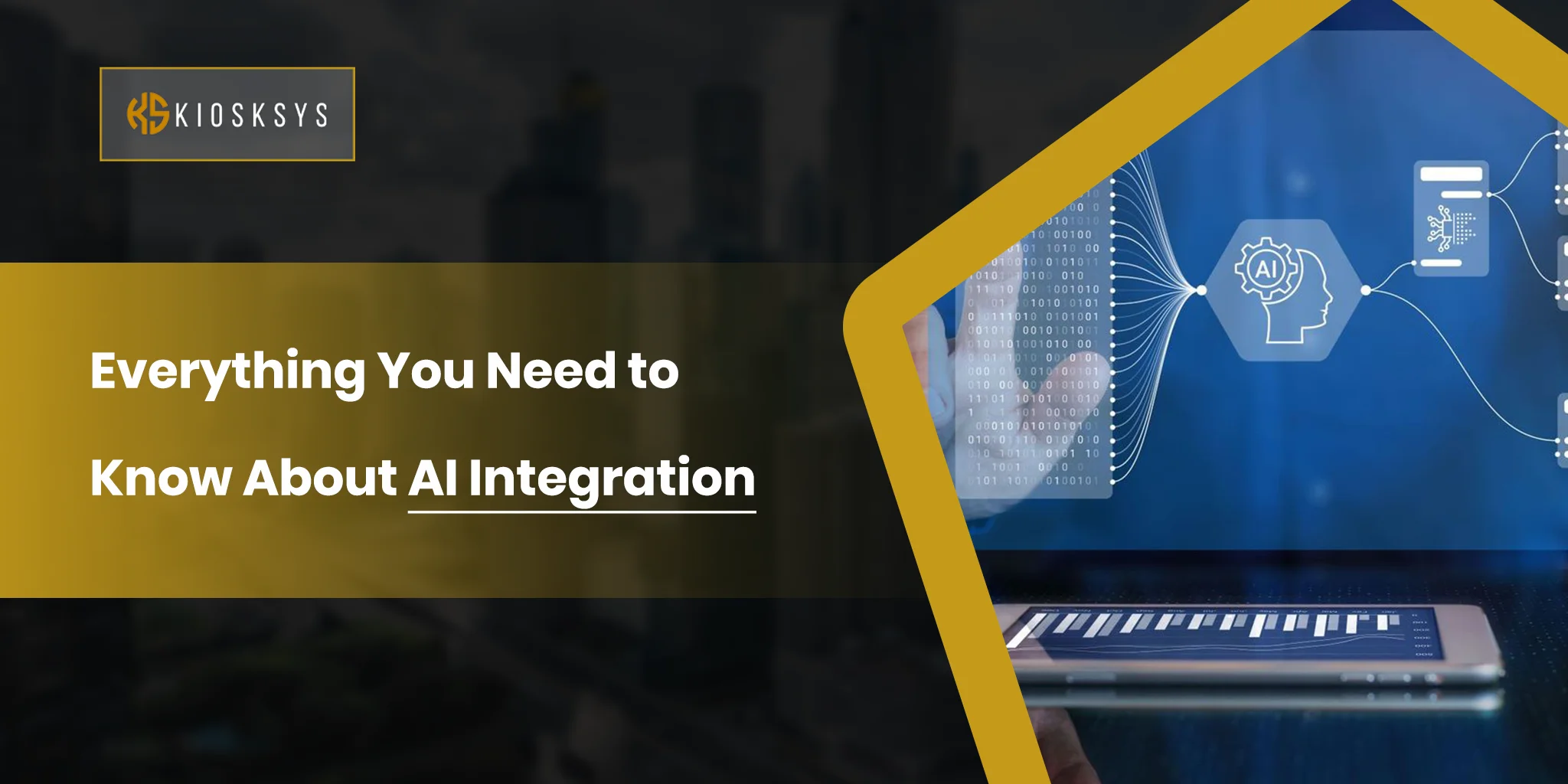
It is basically the process of embedding artificial intelligence into your existing business systems and workflows. This way, they are able to operate smarter and with less manual effort. Instead of buying new software or replacing anything, you just connect AI to what you already have. It’s like an upgrade to make it work better. Consider this:
- You already have a CRM.
- You integrate AI to it, so basically, you are adding intelligence to that system.
- Now, your CRM can predict which leads are most likely to convert.
- This will allow your support team to get an assistant that handles complex things without any human input.
And once it is connected, AI handles much of the analysis and automation behind the scenes.
How AI Integration Works
So, it connects AI models to real business processes. This allows those processes to run with less human involvement and more consistent outputs.
But it’s still different compared to using AI generally. When you integrate AI into a system, it becomes part of the system itself. It runs in the background and connects to live data. This way, it acts on the info continuously.
Some examples doing its work:
- A machine learning model that analyzes sales data every single day.
- A language processing tool reading through contracts and flagging anything that does not match your standard terms.
- An AI sorts and routes customer queries the moment they come in.
How Do Businesses Integrate AI?
It might look like a big process, but if you do it carefully, you can achieve successful integration of AI. Moreover, it’s short and just requires some research.
Set Clear Goals
This is honestly where most businesses go wrong. They hear about AI and get excited. The next thing they are doing is looking at tools before they have even figured out what problem they are actually trying to solve.
Before anything else, you need to understand what you even need the AI for. What is it going to do for you?
Choose the Right AI Tools
There is no single solution that works for every business. Depending on what you are trying to integrate, you could be looking at a unique platform or maybe even a feature that already exists inside software you are paying for.
This is why you need to choose the right AI tools to add to your existing setup.
Prepare the Data
Most businesses underestimate how much work this step actually takes. AI is only as good as the data it learns from, and if your data is messy or full of inconsistencies, your results will reflect that. Preparing your data means making sure it is 100% ready.
Train and Test the AI System
If you are working with a pre-built tool, this step is mostly about configuring it properly and testing it in your specific environment. If you are building something custom, it means training the model on your data and putting it through real test scenarios before it ever touches a live workflow.
Implement AI into Daily Operations
When you launch the AI, start with one team or one workflow. Give people time to actually use it and see how it behaves, and set up a way for them to flag when something looks off.
Monitor and Improve Performance
Even after the AI is running, your job is not done. You need to track whether it is actually hitting the goals you set at the beginning. Watch for model drift, which happens when the data the AI encounters in the real world starts to look different from what it was trained on. Keep an eye on the performance too.
Expand AI Across the Organization
If this first integration works well, other teams will naturally start asking for the same. Expand it, but do it in a coordinated and reliable way.
What Are the Types of AI Integration?
AI can be integrated into almost every part of a business, but the way it is used depends on the challenges an organization is trying to solve. Below are some of the most common implementation approaches businesses use today.
Customer Service Integration
Customer service is often one of the first things where businesses introduce AI. Support teams deal with a high volume of questions every day. Among them, many are repetitive and time sensitive. AI helps manage this workload by:
- Answering common inquiries
- Directing tickets to the right departments
- Analyzing customer sentiment during conversations.
Process Automation
Many business processes involve repetitive tasks that take up valuable time without adding much value. Think about things like entering data and managing approvals. They are all examples of work that can slow teams down when handled manually.
AI helps automate these processes while adding a level of flexibility that traditional automation often lacks.
Predictive Analytics Integration
One of the most valuable uses of AI is its ability to identify patterns hidden within large datasets. Predictive analytics uses previous information to estimate what is likely to happen in the future.
Businesses use it to:
- Forecast customer demand
- Predict potential churn
- Estimate revenue
- Schedule maintenance
Marketing and Sales Integration
Marketing and sales teams often look for methods to better understand their audiences. AI helps by analyzing customer behavior and delivering more personalized experiences.
- It can easily score leads based on their likelihood to convert.
- Recommend relevant content
- Optimize campaigns
- Trigger communications at the right moment
According to research from Deloitte, companies using AI in marketing have reported lower costs while also seeing stronger revenue.
Human Resources Integration
Human resources teams are generally responsible for attracting and retaining talent within a company. AI can support these efforts by analyzing employee feedback and recommending personalized learning opportunities.
Decision Support Integration
AI’s role in decision support integration is to help leaders access better information faster. AI can analyze data from several different sources. It can even identify trends and surface insights that may otherwise be overlooked. This reduces the time spent collecting and organizing information, allowing decision makers to focus on evaluating options and taking action.
What Are the Pros and Cons of AI Integration?
It sounds like it is full of benefits for businesses; however, it’s not that simple. With every part of technology, evolution brings challenges and limitations. Let’s explore them here.
Pros
Efficiency at scale
AI handles high volume, repetitive work faster and more consistently than any human team, without performance dropping over time.
Cost reduction
When AI takes over predictable tasks, operational costs go down, and your existing team can shift toward work that actually requires human thinking.
Better decisions
Live insights are always better because they are generated using data. This way, they beat monthly reports and gut instinct. When the information is better, the decisions are better.
Consistency
An AI system applies the exact same logic to every single task, every single time. In industries where consistency and compliance matter, that is genuinely valuable.
Competitive edge
In most industries right now, the question is not whether your competitors are using AI. It is how far ahead of you they already are.
Cons
Implementation complexity
This is not basically a plug-and-play situation. It takes real technical work and clean data. This means more time and money than what most businesses initially plan for.
Data dependency
If your data is in bad shape, your AI will be in bad shape. Fixing that foundation is often the hardest and most expensive part of the whole process.
Workforce friction
Even well-run rollouts cause anxiety. People worry about job security and resist changes to how they work. Poor communication can mess things up.
Ongoing maintenance
AI needs regular attention. Businesses that treat it as a one-time project end up with systems that get worse without anyone noticing.
Ethical and compliance risks
Bias in models, privacy issues, and automated decisions that cannot be explained all carry real legal and reputational exposure. These need to be built around from the beginning.
Should Your Business Go For AI Integration?
For most businesses, the real question is not whether to integrate AI but where to even start. So, here’s a general explanation by our experts:
If your operations involve:
- High volume
- Repetitive work that involves heavy data
Then, integrating AI will almost certainly pay off for you. The areas where it works best include:
- Customer support
- Finance
- Marketing automation
- Supply chain
However, if your data looks like it is scattered and in poor shape, then there is no point building on a bad foundation. If your team is not ready for the change, you need to fix things up first. This includes focusing on communication and preparation before you focus on tools. The technology is rarely the hardest part of any of this.
For smaller businesses, the barrier has never been lower. AI features are already built into CRM platforms, email marketing tools, and accounting software. You do not need a data science team to get started.
Conclusion
AI integration is not something businesses can comfortably sit out anymore. It is a fundamental shift in how work gets done and how value gets created. The businesses that take it seriously, build the right foundations, and start with clear goals are the ones that end up ahead.
It is not instant, and it is not painless. But the businesses that started two years ago are already seeing the results. The ones starting now still have time. Start with the clearest problem in front of you and go from there.